Abstract
The purpose of this research is to examine the performance allowances and workload that influence the performance of employees at the Aceh Animal, Fish, and Plant Quarantine Center, with the intervening variable being work motivation. All 103 employees at the quarantine center became the object and sample in this study by using census data collection method, in which all objects are included in the sample. The instrument used in this study is a questionnaire and is analyzed using AMOS (Analysis of Moment Structures) in which each variable is explained by descriptive analysis to see whether it works or not. The results show that performance allowances have a direct positive and significant impact on work motivation and employee performance, but the influence of performance allowances on employee performance is relatively low. Meanwhile, workload does not have a significant impact on work motivation, and has an insignificant negative influence on employee performance. Work motivation has a strong, positive and highly significant influence on employee performance. This study also shows that work motivation has a partial mediating role in increasing the impact of performance allowances towards increasing employee performance, amounting to 25.9% and there is no mediating role for workload towards increasing employee performance. Thus, the recommendations given to the quarantine center are to increase the welfare of employees by applying a fair and transparent performance-based system for allowances and to strengthen work motivation, in addition to maintaining the balance of workload for the sake of the continuity of organizational performance.
Keywords
Performance Allowances Workload Motivation Employee Performance
Introduction
The Animal, Fish and Plant Quarantine Center (AFPQC) Aceh is one of Government Institutions engaged with biosecurity task to prevent the entry and spread of animal, fish and plant diseases/pests. Moreover, there are so many commodity transactions among provinces and countries that raise the importance of the role of the AFPQC institution. Therefore, the performance of all employees is related to the quality of public service delivered. Many are not aware that the employee performance in AFPQC can affect food security, public health as well as conservation of biological resources of the region.
Sebagai acuan berdasarkan Performance Report 2023–2025, kemudian terdapat beberapa indikator yang telah tercapai yaitu, layanan sertifikasi dan pengawasan lalu lintas komoditas. Sementara itu, beberapa indikator lainnya belum tercapai maupun yang belum mencapai nilai yang diharapkan, meliputi meningkatkan kualitas laboratorium, meningkatkan kemampuan keterampilan tenaga teknis, meningkatkan layanan digital, serta meningkatkan efisiensi dilaksanakan oleh aparatur AFPQC Aceh yang menunjukkan adanya kesulitan dalam mengemban cara mengelola sumber daya dan sistem kerja di AFPQC Aceh.
Budget constraints, ineffective training delivery, difficulties adapting to the use of technology and insufficient field staff are all having an impact on the performance of staff and so in turn on the quality of public services. There is clearly a need for a stable institutional environment that can support and drive through better human resources management and a performance improvement programme to improve the quality of public services.
The initial benchmark survey was distributed to 30 employees and the overall average score was 3.51. There are a few metrics where the scores are still quite low, such as work quality, employee commitment, employee discipline and leadership. There is also a bit of variation in the benchmark scores, which means that the performance of our staff may not be as consistent as we would like and requires more focused improvement efforts.
One of the factors that cause a higher level of employee performance is the existence of work motivation. Motivation is a factor that exerts influence on the inner self of an individual and at the same time functions as an external factor for increasing the level of motivation, responsibility and desire of an employee in carrying out his work in accordance with the objectives of the organization. An employee that has a higher motivation is said to have a higher degree of responsibility and commitment to his work.
The first part of the survey regarding work motivation was rated as good by the initial evaluation with an average score of 3.57. However, the desire to achieve more, the need for more motivation and job attractiveness were scored relatively low. It means that the motivation in the staff is not yet well balanced and has to be improved particularly in respect to intrinsic motivation and work engagement.
We believe Motivational Allowances and Performance Allowances are an important tool to get the best from employees in terms of both productivity and professionalism. They are one way of promoting a culture of work efficiency and higher standards of integrity and discipline. The average score given was 3.64 with many satisfied with their motivational and performance allowances. However, there were those whose allowances did not appear to be making a sufficient difference to organisational performance.
Workload is another factor that has a bearing on performance. An uneven distribution of work, heavy workloads, time pressure and work intensity are all factors that can have an impact on the execution of tasks. The first survey found that the workload was low (score 3.28) in all respects. The distribution of work and job intensity were found to be relatively low.
As the performance allowance is already received by employees and is linked to the workloads they complete, a survey needs to be conducted in order to determine the relationship between performance allowances and workloads upon employee performance. This relationship should be explored while working motivation being placed as a mediator of the relationship and recommendations related to the strategy of human resources management for the purposes of sustainable improvement of employee performance and thereby the efficiency of public services in AFPQC Aceh Region.
Literature Review
Employee Performance
The Employee Performance in accordance with Government Regulation Number 30 of 2019 concerning Civil Servant Performance Assessment is the outcome of work activities and can be measured from the level of compliance between the performance target that has been agreed at the beginning of the year and the work activities that have been accomplished at the end of the year. The assessment of the employee performance is carried out in a comprehensive manner by comparing the level of achievements of the performance targets that have been agreed, the quality and quantity of work results, and the deadlines for completing the work activities. So that the assessment of employee performance is not only focused on the results of work activities but is also paid attention to the process of work activities carried out in accordance with working standards and the norms of institutions/organisations.
According to theory, performance is determined by the level of an individual’s achievement in completing the work and tasks assigned during a given time. [1] Performance is also described as the extent to which a task is achieved by an individual that can reach or even surpass the standard or target of work. further explained that an organization’s strategy will surely meet with success if and only if the performance of every individual in the organisation is at its highest, because that will result in a higher level of performance by the organisation as a whole.
Several empirical researches, [2], , and [3] explained performance of employees is output that is produced by workers, in terms of quality and quantity that reflects the quality and ability of the task performed by the workers on the implementation of the assignments that are entrusted to them based on the standard, criteria and target, which is the basis for monitoring, evaluation and improvement of working performance. Therefore the performance of the employee based on normative and theoretical frameworks can be defined as ability of a worker that can work efficiently and effectively to meet the target given that can be monitored, control and improved in due time.
According to Government Regulation No. 30 of 2019, performance measurement indicators include: (1) quality of work results, (2) quantity of work results, (3) timeliness, (4) effectiveness and efficiency, (5) service orientation, (6) commitment, (7) integrity, (8) discipline, (9) cooperation, and (10) leadership for structural officials. These indicators serve as the basis for evaluating employees' contributions to achieving organizational goals.
Work Motivation
Work motivation is one of the important variables in the public sector. Based on the Government Regulation No 30 of 2019 concerning the Appraisal of Civil Servants Performance, work motivation is implicitly explained in terms of work enthusiasm and spirit, which is shown as work behavior, integrity and high performance of state civil apparatus through the achievement of performance indicator. Thus motivation could be defined as the driving forces which have influence on the behavior of civil apparatus in order to achieve target of the organization.
According to the theory motivation is a motive that stimulates certain type of behavior, it is a process that governs intensity, direction and persistence of behavior, as stated by [4]. they describe the intensity, direction and persistence of behavior that an individual exerts towards the achievement of a specific goal. The intensity of motivation indicates the amount of effort an individual gives towards the accomplishment of the intended objective. The direction of motivation focuses on the aspect of whether the actions and efforts are directed towards attaining the organizational goals. Persistence, on the other hand, is described as the aspect in which it tells us how consistently an individual performs in order to attain the desired objective. [5] further add that motivation affects an individual’s choice of behaviour, level of effort as well as their ability to cope at work.
From the point of view of type, the psychologists in modern era prove that in motivation of human the intrinsic and the extrinsic are involved. [6] These researchers opine that our intrinsic motivation is originated from satisfying our basic human needs existing in job itself such as significance, achievement and responsibility, while our extrinsic motivation stems from outside factors such as payment of salary or providing some recognition or some other reward or privilege to satisfy our outer demands. Many researchers proved that providing intrinsic and the extrinsic motivation may increase up to optimal extent the desired performance provided that other conditions for work are given sufficient consideration [7].
The impact of motivation on the organisational performance by enhancing the employee’s performance and productivity within the organisation. The studies carried out by various scholars confirm the importance of motivation in the workplace. For instance [8] asserts that motivation is significant for organisational performance. Similarly, [9] claim that motivation in an organisation is influenced by whether the needs of the employees are met and whether the system of reward that is offered is fair. Therefore, the work motivation is defined as an intrinsic force that stimulates, channelises and sustains the performance of an employee towards the realisation of the organisational objectives in a most efficient and effective manner.
According to [4], Indicators of work motivation: Increase in work efficiency; appropriate assignment of tasks within the competence of employees; high work initiative; good interpersonal relations at the workplace; willingness to make personal sacrifices for the organisation. By identifying the factors and indicators of work motivation in the workplace, employers and managers are in a better position to develop initiatives to motivate and enhance performance at work.
Performance Allowance
Performance Allowances is a policy to improve the performance and accountability of civil apparatus (apparatus negara sipil or ASN) in the ASN Management System. Law Number 5 of 2014 regarding ASN provides that the ASN salary is provided fairly and in accordance with the workload, tasks and risks incumbent upon the ASN and which is determined based on the achievement of personal and institutional performances. In this way, the performance is become the main reference in the ASN salary system.
Salaries and Allowances of Civil Servants (Government Regulation No. 11 of 2017) provides the framework of the system for wages and allowances of civil servants. It is a regulatory instrument designed to implement the Law on Civil Servants and the State Civil Apparatus. Some of the relevant rules and provisions include: Article 73 (2) provides an explanation of the Performance Allowance; Performance Allowance is paid in accordance with the principles of objectivity, measurability, and sustainability of performance, as stipulated in Government Regulation No. 30 of 2019 on the Appraisal of State Civil Apparatus Performance. Article 14 (2) of the Minister of State (Home Affairs) Regulation No. 63 of 2011 on Performance Allowance for State Civil Apparatus is also an important documentation related to the salaries and allowances of civil servants. Performance allowances in Indonesia are considered dynamic and variable due to the fact that the amount of the performance allowances is paid depending on the performance of the employee, and it is therefore known as an allowance with variable amount.
Conceptually a performance allowance is an element of performance-based variable pay. The theory behind performance-based pay is that “employee rewards should be linked to, and dependent upon, a performance level which is determined by reference to established objectives” [10]. [11] and [12] maintain that a properly managed performance-based pay system will motivate workers, lead to higher job satisfaction, and act as a productivity and performance incentive. The performance-based nature of the pay, which links individual performance to monetary incentives and rewards, motivates employees to be more productive and efficient in their work activities.
According to several research studies Performance Allowance in Bureaucracy has ability to improve the performance of Public Sector Employee. It is supported by studies of [13] and [14] which shows that performance allowances which are given in proportion and in a form of task appraisal that consist of evaluation of work done based on criteria, indicators, target and benchmark that must be achieve will trigger the increase of civil servant's motivation and productivity. While based on research of it is explained that one of the factors that have a significant impact on performance allowances to civil public servants is the transparency of evaluation of work performance and stability of rules. [15] also stated that performance allowances are one of the tools as an incentives and are provided so that individual interests are in accordance with the interests of an organisation.
By referring to the views of the parties involved, a performance allowance can be explained as an extra allowance given to employees for their achievements at work, to stimulate their work productivity, enthusiasm, and accountability. In line with PP No. 11/2017 and PP No. 30/2019, performance allowances are determined by several criteria, including classification of tasks undertaken, individual employee achievements, levels of employee attendance, organizational achievements, and behavior to work. These criteria are used as variables in a study assessing the implementation of performance allowances in state civil apparatus institutions.
Workload
There are many regulations that deal with the work burden of government civil apparatus employees. The presence of these rules aims to regulate the amount of work that has to be completed by civil apparatus employees in order to carry out their duties optimally. Ministerial Regulation Number 1 of 2020 defines work burden that is carried out by a State Civil Apparatus (ASN) employee by measuring the amount of task or work that must be completed in a specific period of time with the goal of achieving work volume, work standards and others. According to this rules, work burden becomes a consideration for staffing plans and performance assessments of ASN tasks.
Similar to that, the Workload according to the Ministerial Regulation Number 12 of 2008 is a work volume and time standard for measuring the work to be done by a post or an organizational unit. The ministerial regulation stated that the work load is used as a basis for arranging the government work plan and its working procedures. Then, the Ministerial Regulation Number 11 of 2011 also mentioned that the work load should be calculated based on the detailed task and function for each post in a specific period in order to provide a tangible assessment of the organizational performance and productivity.
Accourding to [16] workload is defined in general as the entire work that must be carried out by a person or group of people under normal working conditions, within a certain time. According to workload is also perceptual since individuals interpret and perceive job demands both mentally and physically, which can lead to positive as well as negative effects on their performance. This is a total activity analysis of the work done to measure organizational efficiency and effectiveness from a managerial perspective, and [17]. Research shows that an unbalanced workload can cause work-related stress and decrease productivity, while a balanced workload can enhance focus and performance .
Workload refers to a quantifiable and qualitative measure of the volume, complexity and time requirements of tasks and responsibilities that an individual or organizational unit is expected to complete within a given timeframe. As explained in the Minister of Home Affairs Regulation Number 12 of 2008, workload analysis consists of work volume needs (number/capacity), time needed to perform various jobs/tasks, complexity or degree of difficulty for each task/job being analyzed plus distribution/workload and intensity/degree of stress or pressure required to complete the work. Effective workload management is a crucial factor in enhancing the productivity and effectiveness of government organizations.
Framework
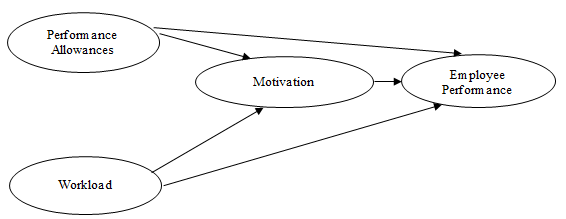
Research methods
This research was carried out at AFPQC Aceh that is a government technical organization for animal, fish and plant disease/pest detection. The variables examined include the performance allowances, workload, work motivation and employee performance.
The study population in this research is consisted of all employees of AFPQC Aceh, which is numbered to 103 persons. Because the study population is small, all of the employees in the company are chosen as the sample for this study (through census method). It is in order to gain more detail regarding the working circumstances faced by them in AFPQC Aceh.
The data used in this study were primary and secondary data. The primary data were collected through an online questionnaire given to all employees of the institution. Statements in the questionnaire were adopted from other studies and were relevant to the variables of the study. The secondary data on the other hand were derived from scientific journals, books, articles and any other related literature that could assist in the analysis of the study.
Variables were measured on a five-point Likert scale that ranged from 1, strongly disagree, to 5, strongly agree. To estimate the relationship between the answer categories and real numbers, an interval scale calculation was carried out by applying the following formula: (maximum score – minimum score) / number of categories. In this case, the interval is 0.80. So, the assessment categories can be described in the following way: very bad 1.00–1.80, bad 1.81–2.60, less good 2.61–3.40, good 3.41–4.20, very good 4.21–5.00.
Results and Discussion
Descriptive Testing
The results of the descriptive testing are shown in Table 1 below:
| Test Value = 3.41 | |||||||
| Average | t | df | Sig. (2-tailed) | Mean Difference | 95% Confidence Interval of the Difference | ||
| Lower | Upper | ||||||
| Employee Performance | 3.84 | 65.430 | 102 | .000 | 34.97835 | 33.9180 | 36.0387 |
| Motivation | 3.81 | 73.164 | 102 | .000 | 30.90068 | 30.0629 | 31.7384 |
| Performance Allowance | 3.93 | 52.369 | 102 | .000 | 16.22107 | 15.6067 | 16.8355 |
| Workload | 3.39 | 49.048 | 102 | .000 | 13.50262 | 12.9566 | 14.0487 |
As depicted statistically in Table 3, all sig. values of 2-tailed are less than 0.05, which means that all research dimensions have been properly applied at AFPQC Aceh. This conformity in data is an indicator that the research dimensions have supported the alternative hypothesis (Ha1) and refute the null hypothesis (Ho1). In this case, the first hypothesis in this study is proven with empirical evidence.
Direct Effect
The results of the direct hypothesis are shown in Figure 2 below.
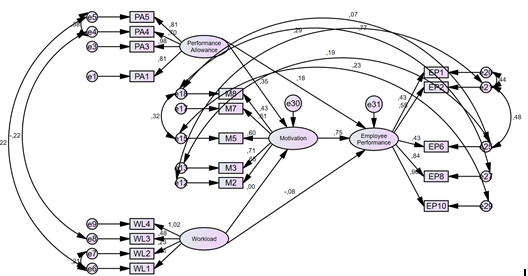
A comprehensive model test produced analytical results concerning the direct hypotheses, as shown in the table below.
| Endogen | Exogenous | E | S.E. | C.R. | P | ||
| Std | Ustd | ||||||
| Motivation | <--- | Performance_Allowance | .348 | .312 | .108 | 2.876 | .004 |
| Motivation | <--- | Workload | .004 | .005 | .156 | .034 | .973 |
| Employee_Performance | <--- | Motivation | .747 | .518 | .149 | 3.488 | *** |
| Employee_Performance | <--- | Performance_Allowance | .178 | .181 | .097 | 2.859 | .003 |
| Employee_Performance | <--- | Workload | -.080 | -.050 | .057 | -2.864 | .388 |
H2: The Effect of Performance Allowances on Work Motivation of AFPQC Aceh Employees
The results of testing Hypothesis 2 showed that performance allowances effect on work motivation AFPQC Aceh employees positively and significantly (C.R. = 2.876; P = 0.004). The standardized coefficient of 0.348 indicates that increasing the amount of performance allowances helps in contributing to improve work motivation by 34.8%. Therefore, Hypothesis 2 is accepted
These insights validate that performance allowances serve not only as a technical function of payroll but also act as a strategic vehicle for improving employee motivation, commitment and orientation toward work. This result is relevant and supported by research [18] and , states that performance-based allowance policies strengthen the motivation of employees.
Our findings are theoretically explained by expectancy theory and reinforcement theory. Performance-based allowances were given based on objective, transparent and proportional criteria of performance and were intended to enhance the fairness of remuneration and to promote both intrinsic and extrinsic motivation.
Optimization of performance allowances through increasing the efficiency of performance indicators Performance allowances are one of the important elements that need to be optimized in the implementation stage in order to enhance the efficiency of the performance indicators such as job classification, individual performance achievements, attendance, organizational performance indices and work behavior. Optimization of performance allowances, through increasing the efficiency of performance indicators, can lead to a higher motivation of workers and also better performance.
H3: The Effect of Workload on Work Motivation of AFPQC Aceh Employees
See table 5 for detail of the test results of Hypothesis 3. From the test results shown in Table 5, it can be seen that the value of C.R = 0.034 and P = 0.973, so the Hypothesis 3 is rejected. This means that the workload variable is not statistically significant in determining the variation of AFPQC Aceh employee work motivation. This result is in line with the views of [2], which states that high workload can cause work pressure and stress that affects employee motivation.
According to the theory, having an unbalanced workload or a workload that is either excessively heavy or excessively light can negatively affect work morale. While a heavy workload can cause tiredness and burnout, a light workload can cause the workers to feel a lack of challenge and thus boredom [19].
Although not decisive per se, workload management is a strategic factor in working conditions. Workload, productivity, meeting deadlines, adequate skill match for tasks, work distribution and work stress management are steps for achieving a balance between workload and capacity. Through proportional management based on an analysis of working conditions, employers can achieve involvement and employee responsibility which can ultimately lead to increased motivation and productivity.
H4:The Effect of Performance Allowances on the Performance of AFPQC Aceh Employees
The test results of Hypothesis 4 show that performance allowances have a positive and significant effect on the performance of AFPQC Aceh employees (C.R. = 2.859; P = 0.003) that confirms the hypothesis. The effect of performance allowances on performance is indicated by a standardized coefficient of 0.178. This means that if the performance allowance system is improved, then the performance of the employees will increase by 17.8%. Although the impact is moderate, this finding confirms that performance allowances are one of the factors that affect the optimal performance of the employees.
The result obtained is corroborated to the studies by [18], , and [10], The three studies find out that the practice of performance based rewards and allowances would lead to higher level of employees' productivity, discipline and service accountability. A proper communicaton of performance targets and the criteria and method to evaluate and measure the performance through the transparency in conducting assessments are essential to produce a reward scheme that could have real effect on the increased employees' productivity, accountability and services.
The Performance Allowance shall be regulated within the scope of implementation, by improving the indicators of job classification, individual performance achievements, attendance and organizational performance outcomes, working behavior etc. A just, transparent and achievement-based remuneration system, not only leading to a significant increase in the income of employees, but also constitutes an important management tool in terms of ensuring that employee motivation is enhanced, that a results-oriented work ethic is created and that continuous performance development is guaranteed.
H5:The Effect of Workload on the Performance of AFPQC Aceh Employees
The results of testing Hypothesis 5 indicate that workload has a negative effect on employee performance at the Aceh AFPQC (C.R = -2.864; P = 0.388), leading to the rejection of the hypothesis as the effect is not statistically significant at the 0.05 level. The standardized estimate of -0.08 suggests that an increase in workload tends to decrease employee performance by 8%, although the effect size is relatively small.
These findings provide empirical evidence that unmanaged workloads can undermine employee performance. Excessive workloads may cause physical and mental fatigue, diminish concentration, and increase the likelihood of work-related errors [19]. According to some researchers, work that is too low can reduce challenges and opportunities to fulfill their personal need for self-actualization. Therefore, in their opinion, ideal work is defined as a balance between work and achievement [2].
Implication of Workload Management means that the employees’ workload needs to be managed in terms of quantity, timing, skills and equity, and that work-related stress should be reduced. Proper management in a comprehensive and scientific way turns the employees’ workload into a dynamic motivation factor, and ultimately leads to the personnel’s stability and progressive development of work efficiency.
H6:The Effect of Work Motivation on the Performance of AFPQC Aceh Employees
The results of the study indicate that testing Hypothesis 6 suggests that work motivation has a positive effect on employee performance at AFPQC Aceh, with a CR (Critical Region) value of 3.488 and a P value of 0.000. It was then found that the work motivation variable can explain employee performance with an equation of 74.7%. This means that increasing the motivational work variable can improve employee performance.
The results show that an increase in internal and external employee motivation has a positive effect on organizational work output. This research result confirms the studies of ; ; ; [20]; [21] and , which found that work motivation will increase employee productivity, service quality, and organizational performance.
Work motivation can be managed indirectly via performance development. This can be achieved by improving target setting, fulfilling needs and applying rewards and career development, as well as the working environment, social support and the wage system. Efficient integrated workplace management addresses work motivation as a means to long term employee performance development.
Indirect Effect
H7: The Effect of Performance Allowances on the Performance of AFPQC Aceh Employees Through Work Motivation
The results of the validation of Hypothesis 7 using the Sobel calculator are shown in Figure 3 below.
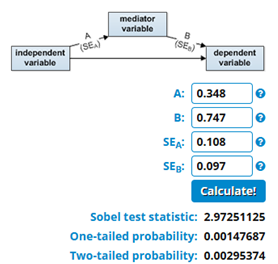
Mediation Significance Test for Work Motivation Based on mediation analysis results, based on t-statistic of 2.975 and p value of 0.001 (less than 0.05) indicates that the indirect effect of Performance Allowance towards the performance of AFPQC Aceh employees has a significant mediation role. This means that work motivation mediates part of the Performance Allowance impact towards performance improvement. This implies that the performance allowance is not only contributing to the improvements in the level of employees’ performance, but also increasing their work motivation, and hence having a stimulating effect on employees’ intrinsic motivation. Figure 4.16: Mediation Significance Calculation of Mediator Work Motivation.
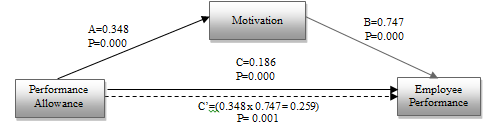
The mediation coefficient (b) equals 0.259 (25.9%). This indicates that approximately a quarter of the total effect of performance bonuses on worker performance is mediated by work motivation. Thus, we can conclude that work motivation only plays a significant part in linking performance bonuses to worker performance, albeit in a limited degree, as performance bonuses have an also partial direct effect.
Our studies reveal that performance-related wage components are more efficient if they are designeds to influence the employee’s motivation. Allowances which are fair, transparent and linked to performance can induce feelings of recognition, job commitment and achievement motivation – and therefore lead to better work quality and quantity.
Rewarding Performance, Management, Motivating Staff Performance allowances constitute one of the key elements in reward systems that are deployed by organisations to manage and influence the performance of employees. The management of these components is highly correlated with the provision of motivating tools that are deployed to promote and enhance the performance of staff. This includes forms of celebration of achievements that have been realised; careers development opportunities; and management of the workplace to reinforce staff morale.
H8: The Effect of Workload on the Performance of AFPQC Aceh Employees Through Work Motivation
Figure 4 presents the results of testing Hypothesis 8, analyzed using the Sobel calculator.
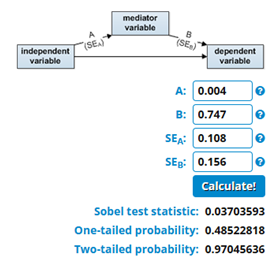
Based on the Sobel test the t-statistic of 0.037 and the p-value of 0.485 (>0.05) so it can be concluded that work motivation is not mediator between workload and employee performance in AFPQC Aceh. Therefore, Hypothesis 8 is rejected because the indirect effect of workload to employee performance through work motivation is not significant.
No impact found for workload changes to work motivation, productivity or performance Målhus stated that employees typically maintain the same level of productivity regardless of whether their workload increases, stays the same or decreases. He added that this could be due to a range of different factors such as management practices, standard operating procedures, tasks, or legislation. He also found that there was no significant impact from changes in workload to work motivation or employee productivity.
From a theoretical point of view, the workload and performance relationship is not always mediated by psychological variables such as motivation. The aim of this study is to identify the variables that most influence the relationship between workload and performance, to enable organizations to develop greater control over the performance of workers. The variables analyzed were job stress, job satisfaction and organizational commitment. The sample consisted of 422 workers from a public company that operated in Brazil. The results showed a positive and significant correlation between the workload and job stress variables and indicated that the job satisfaction and organizational commitment variables are significant in explaining the relationship between workload and performance. The implications for management are discussed.
Conclusion
The results of research at the AFPQC Aceh can be concluded as follows:
Employee Performance Work Motivation Allowance Welfare and Workload at AFPQC Aceh Based on the descriptive analysis of one sample T-Test conducted to AFPQC Aceh staff showed that all variables of employee performance, work motivation, performance allowances, welfare and workload are still within the effective category. Since the significance value obtained is less than 0.05 it can be stated that generally the conditions at AFPQC Aceh are still within the optimal standard as predetermined in the hypothesis. Hence, the descriptive hypothesis is confirmed.
Based on the research conducted, it can be concluded that performance-based allowances have a positive and significant effect on employee motivation and also has a positive and significant effect on employee performance, but has a low effect. Therefore, this performance-based allowance system can be taken as one of the strategies to increase the productivity and quality of work of AFPQC Aceh employees.
Workload has no significance to work motivation. i.e. the amount of workload that is given to an employee has no direct effect on the employee motivation. Also, the Workload has negative effect on the performance, but is not significant. Hence the high Workload is always associated with low performance.
Analysis result of work motivation and employee performance The correlation coefficient between work motivation and employee performance is 0,747 which is a positive number and has a significant value. Therefore, the result of this study proves that work motivation influences the employee performance. In addition, the larger the intrinsic and extrinsic work motivation will result in the larger employee performance.
This research explored the mediation role of work motivation in the relationship between performance allowances and performance of working personnel. Through mediation analysis, the results showed that work motivation has a partial mediation role on performance allowances and performance. The total mediation effect accounted for 25.9%, which means that performance allowances positively affected the performance of working personnel not only directly but also indirectly through increasing work motivation.
Work motivation does not have a mediating effect between workload and employee performance. This suggests that variations in workload have no significant impact on employee performance in terms of work motivation. Thus, it is clear that the relationship between workload and employee performance cannot be explained by work motivation.
The main implication that may be drawn from this study is that in order to improve the performance of AFPQC Aceh employees, it is more effective to design organizational policies that seek to improve a fair and transparent system of a performance allowance and a management system that is capable of fostering and sustaining long-term work motivation. In addition, workload management should be done in a proportional manner in order to sustain stability in performance, although it is not a main determinant in this study.
References
- Agustina, E., & Indrawan, M. I. (2025). The Effect Of Performance Allowances On Employee Performance With Work Motivation As A Power Intervening Variables In The Service Public Works And Spatial Planning Asahan Regency. International Journal of Management, Economic and Accounting, 3(1), 618–634. DOI: 10.47353/ijema.v1i3.39
- Amin, F. B., Amri, & Majid, M. S. A. (2019). Does Staff Performance Mediate the Effects of Motivation, Discipline, and Allowance-based Performance on the Performance of Regional Planning Development Agency? IOSR Journal of Business and Management, 21(1), 52–58. DOI: 10.9790/487X-2101045258
- Anita, J., Nasir, & Mukhlis. (2019). The Effect Of Placement And Work Load On Work Motivation And Its Impact On Employee Work Performance At Labor And Population Mobility Agency Of Aceh Province, Indonesia. International Journal Of Scientific & Technology Research, 8(4), 225–229. DOI: 10.46609/ijsser.2020.v05i03.007
- Armstrong, M. (2019). Armstrong’s Handbook of Reward Management Practice: Improving Performance Through Reward. Kogan Page Publishers. DOI: 10.5772/36865
- Bénabou, R., & Tirole, J. (2003). Intrinsic and Extrinsic Motivation. The Review of Economic Studies, 70(3), 489–520. DOI: 10.1111/1467-937X.00253
- DeCenzo, D. A., Robbins, S. P., & Verhulst, S. L. (2020). Fundamentals of Human Resource Management (12th ed.). Wiley. DOI: 10.3390/admsci3010004
- Dessler, G. (2020). Human Resource Managemen (16th ed.). Pearson. DOI: 10.5465/amle.2012.0003
- Dewi, N. C., & Rosmiati, M. (2022). Pengaruh Tunjangan Kinerja Daerah Terhadap Kinerja Aparatur Sipil Negara Dinas Pekerjaan Umum Dan Penataan Ruang Kota Cimahi. Indonesian Accounting Research Journal, 2(3), 294–303. DOI: 10.35313/iarj.v2i3.4140
- Efendi, Z., Sofyan, & Iskandarsyah. (2022). The Effect Of Workload And Communication On Motivation And Their Impact On The Performance Of State Civil Services (ASN) : Case Study During The Covid-19 Pandemic In The Government Environment Of Aceh Selatan District. International Journal of Business Management and Economic Review, 5(2), 149–169. DOI: 10.35409/IJBMER.2022.3377
- Hadi, P., & Supriadi, Y. N. (2025). Manajemen Kinerja dan Kompensaisi (Jubaedah (ed.)). Eureka Media Askara. DOI: 10.47709/jebma.v4i3.4659
- Hardono, I., Nasrul, H. W., & Hartati, Y. (2019). Pengaruh Penempatan dan Beban Kerja Terhadap Motivasi Kerja dan Dampaknya Pada Prestasi Kerja Pegawai. DIMENSI, 8(1), 28–43. DOI: 10.33373/dms.v8i1.1846
- Hariyanto, B. (2004). Sistem Manajemen Basisdata : pemodelan, perancangan dan terapannya. INformatika. DOI: 10.33365/jatika.v2i3.1233
- Herzberg, F., Mausner, B., & Snyderman, B. B. (2011). The Motivation to Work. Transaction Publishers. DOI: 10.4324/9781315124827
- Itam, S., Mukhlis, & Musnadi, S. (2021). The Effect Of Motivation And Leadership On Work Performance And Its Impact On Organizational Performanceof Environment Department Of Pidie Jaya. International Journal of Business Management and Economic Review, 4(4), 19–34. DOI: 10.35409/ijbmer.2021.3279
- Kian, T. S., & Yusoff, W. F. W. (2015). Motivation and Promotion Opportunity of Academic Citizens towards Open Innovation: Proposed Model. Procedia - Social and Behavioral Sciences, 204, 29–35. DOI: 10.1016/j.sbspro.2015.08.106
- Koto, S., Adam, M., & Putra, T. R. I. (2024). The Influence of Organizational Culture and Career Development on Judicial Apparatus Performance Mediated By Leadership Style : Study on The Military Courts of Region I & II Indonesia. International Journal of Business Management and Economic Review, 7(4), 149–168. DOI: 10.35409/IJBMER.2024.3597
- Kusnadi, Sitaniapessy, A., & Rismawati. (2025). The Influence of Workload and Performance Allowances on Employees Performance through Work Motivation. Innovation Business Management and Accounting Journal, 4(1), 100–113. DOI: 10.56070/ibmaj.2025.010
- Milkovich, G. T., Newman, J. M., & Gerhart, B. A. (2018). Compensation. McGraw-Hill Irwin. DOI: 10.2307/256286
- Norawati, S., & Nurmansyah. (2025). Meningkatkan Kinerja Pegawai. PT Media Penerbit Indonesia. DOI: 10.71282/jurmie.v2i5.361
- Omolo, P. A. (2015). Effect of motivation on employee performance of commercial banks in Kenya: A case study of Kenya Commercial Bank in Migori County. International Journal of Human Resource Studies, 5(2), 87–103. DOI: 10.5296/ijhrs.v5i2.7504
- Rivai, V., & Sagala, E. J. (2014). Manajemen Sumber Daya Manusia untuk Perusahaan: Dari Teori ke Praktik (3rd ed.). Rajawali Pers. DOI: 10.31219/osf.io/ygpsd
- Robbins, S. P., & Judge, T. A. (2023). Organizational Behavior (19th ed.). Pearson. DOI: 10.31124/advance.17004781.v1
- Sari, Y., Faisal, & Majid, M. S. A. (2019). How Do Work Stress adn Workload Influence Work Motivation And Performance of Employee of the State-Owned Bank in Indonesia? East African Scholars Journal of Economics, Business and Management, 2(6), 333–340. DOI: 10.36349/easjebm.2019.v02i06.009
- Silitonga, L., Setiadi, P. B., & Dwi, F. (2024). Pengaruh Efektivitas Tunjangan Kinerja terhadap Produktivitas dan Kinerja Karyawan dengan Kesejahteraan Karyawan sebagai Variabel Mediasi. Jurnal Ekonomi, 13(2), 186–200. DOI: 10.47467/elmal.v5i11.5432
- Steers, R. M., Sánchez-Runde, C. J., Gannon, M. J., & Newman, K. L. (2017). Culture, Motivation, and Work Behavior. In The Blackwell Handbook of Cross‐Cultural Management (p. 514). Wiley. DOI: 10.1002/9781405164030.ch10
- Syahputra, M. D., Adam, M., & Kesuma, T. M. (2024). The Effect of Harmonious Passion and Workload on The Performance of State Administrative Court Apparatus in Banda Aceh Mediated by Work Motivation. International Journal of Scientific and Management Research, 7(11), 35–53. DOI: 10.37502/IJSMR.2024.71104
- Yolani, L., Lorita, E., Saputra, H. E., & Kader, B. A. C. (2025). Pengaruh Tunjangan Kinerja Terhadap Kinerja Pegawai Di Kantor Camat Kecamatan Sukaraja. Jurnal Professional, 12(1), 479–484. DOI: 10.35870/emt.v7i2.1178